
Research, Research Articles
Occlusal types shape oral microbiome stomatotypes and metabolic landscapes: A multi-omics perspective on host-microbe interaction
Yufeng Duan1,a, Zheng Liu2,3,a, Wenting Lu1,a, Ning Zhao1, Lingjun Yuan1, Zhenxia Li1, Ting Zhou1, Shengzhao Xiao1, Dian Jing1, Xiaowen Zheng1, Wentao Shi4, Chao Liu1,*, Haixia Lu5,*, Qiang Feng6,* and Bing Fang1,*
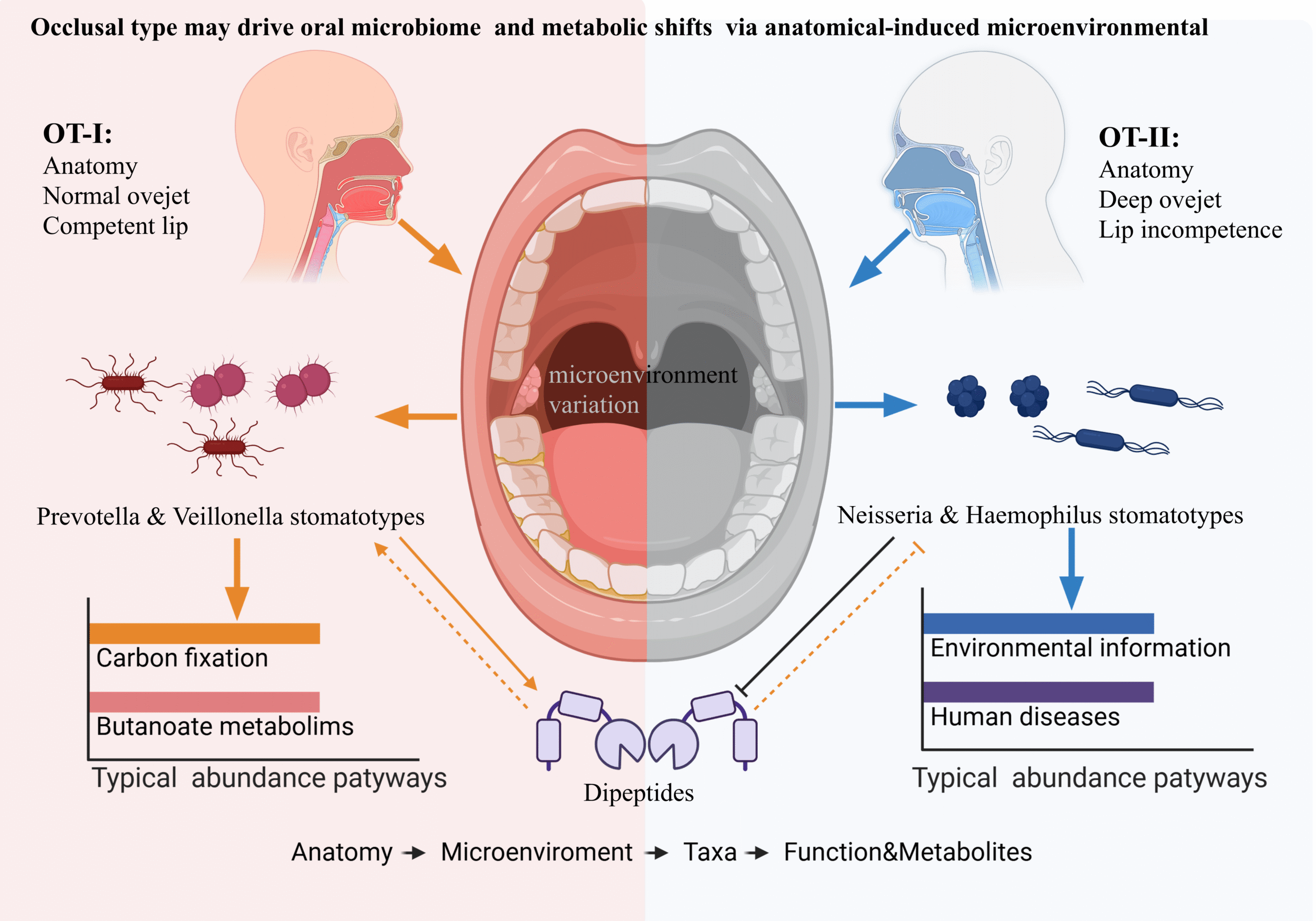
This study reveals how occlusal types shape oral microbiome “stomatotypes” and metabolic profiles in adolescents. It offers fresh insights that host anatomy drives microecology which may be associated with personalized oral health.

Genomic epidemiology of carbapenemase-producing Klebsiella pneumoniae circulating in a Chilean tertiary-care hospital (2021–2022): Molecular characterization, resistance-virulence convergence, and clinical associations
Gustavo Araya1,2, Alhejandra Álvarez1, Carolina Arellano1, Rodrigo Bravo3, Abraham Gajardo4,5, Boris Barrera6, Francisco Silva6 and Roberto M. Vidal1
This study characterized carbapenem-resistant Kp (CR-Kp) strains isolated at the Hospital Clínico Universidad de Chile (HCUCH) 2021-2022 and explored associations with clinical characteristics.

Sugar-induced cell death (SICD) in Saccharomyces cerevisiae: insights into nitrogen-mediated rescue and apoptotic cell death pathways
Raveena Parbhudayal and Hai-Ping Cheng
This study examined mechanisms through which yeast sugar-induced cell death can be prevented. High concentrations of glucose induced a catastrophic response that was only rescued by highly preferred nitrogen sources and by preventing nuclear localization of specific cell death proteins.

TOR-dependent regulation of the yeast homolog of the juvenile Batten Disease-associated gene CLN3
Vijaykumar Pillalamarri1, Samuel W.M. Gatesy1, Amanda E. Grassel1, Lucienna Wolf1, Justin P. Whalley2 and David M. Mueller1,*
This study identifies conditions and genes that induce BTN1 expression in yeast. We show that BTN1 expression is regulated by translational control and by the mTOR1 pathway. An understanding of when and why BTN1 expression will aid in understanding the expression of CLN3, which may be helpful in the treatment of this devastating disease.

Metagenomic and microbiological analyses of historical manuscripts for bacterial community profiling and bacteria-related biodeterioration assessment
Esra Keles1,* and Ozge Celik2
By documenting both culturable and non-culturable taxa, this work provides a foundational dataset for understanding bacterial contributions to manuscript stability and offers a methodological framework for future research on biodeterioration dynamics in Islamic and global documentary heritage.

Overcoming phagocytosis resistance of hypervirulent Klebsiella pneumoniae by directly targeting capsules
Shogo Tsubaki1, Touya Toyomoto1, Rika Tanaka2,3, Jin Imai4,5, Juntaro Matsuzaki6,7, Katsuto Hozumi2 and Hitoshi Tsugawa1,5*
This study highlights a promising strategy for disarming hypervirulent K. pneumoniae by directly targeting its key virulence factors and provides novel insights into antibacterial therapeutic approaches against this clinically significant pathogen.

VapA/Scs2 sustains polarized growth in Aspergillus nidulans by maintaining AP-2-mediated apical endocytosis
Xenia Georgiou1, Sofia Politi1, Sotiris Amillis1 and George Diallinas1,2,*
To explore the functional significance of ER–PM contact sites in filamentous fungi, we identified and genetically characterized all Aspergillus nidulans proteins homologous to Snc2/VAP, Ist2, or tricalbins.

Genetic make-up and regulation of the L-lysine biosynthesis pathway in Vibrio natriegens
Elly Straube1, Johannes Radde1, Thi Van Anh Tran1, Negin Keihani Yazdi1, Rubén Crespo Blanco1, Ha Thanh Le2, Cláudio J.R. Frazão1 and Thomas Walther1,*
This study analysed the make-up and regulation of the biosynthetic pathway for L-lysine and related L-aspartate family amino acids (AFAAs) in Vibrio natriegens DSM759 to provide a comprehensive basis for future metabolic engineering endeavours aiming at developing this strain into an amino acid overproducer.

Regulation of extracellular vesicles for protein secretion in Aspergillus nidulans
Rebekkah E. Pope1, Patrick Ballmann2, Lisa Whitworth3 and Rolf A. Prade1,*
This study reveals that Aspergillus nidulans boosts extracellular vesicle production when ER-trafficked enzymes are induced, uncovering how fungi remodel their secretome through vesicle-mediated secretion to adapt to changing environments and biofilm formation.
Extracellular calcium triggers unique transcriptional programs and modulates staurosporine-induced cell death in Neurospora crassa
August 9, 2014
The results presented here reveal that in Neurospora crassa, extracellular Ca2+ modulates cell death and the transcriptional alterations induced by staurosporine, and lead to the identification of two novel putative Ca2+-binding proteins, encoded by the NCU08524 and NCU06607 genes.
Multiple metabolic requirements for size homeostasis and initiation of division in Saccharomyces cerevisiae
August 1, 2014
This article reveals an unexpected diversity in the G1 cell cycle phenotypes of metabolic and biosynthetic Saccharomyces cerevisiae mutants, suggesting that growth requirements for cell division are multiple, distinct and imposed throughout the G1 phase of the cell cycle.
Effect of paraquat-induced oxidative stress on gene expression and aging of the filamentous ascomycete Podospora anserina
June 22, 2014
In this article, paraquat is used to experimentally induce strong cellular oxidative stress in Podospora anserina wild-type cultures of different age, finding that this treatment has profound effects on gene expression, growth and lifespan.
Heat shock protein 90 and calcineurin pathway inhibitors enhance the efficacy of triazoles against Scedosporium prolificans via induction of apoptosis
June 2, 2014
This article reports for the first time that posaconazole (PCZ) or itraconazolein (ICZ) in combination with the calcineurin inhibitor tacrolimus or the Hsp90 inhibitor 17-demethoxy-17-(2-propenylamino) geldanamycin renders S. prolificans exquisitely sensitive to PCZ or ICZ via apoptosis.
At neutral pH the chronological lifespan of Hansenula polymorpha increases upon enhancing the carbon source concentrations
May 20, 2014
The data presented in this work indicate that in H. polymorpha at neutral pH the chronological lifespan invariably extends upon increasing the carbon source concentration.
Salt stress causes cell wall damage in yeast cells lacking mitochondrial DNA
March 3, 2014
In this work, the authors report that salt stress causes cell wall damage in yeast cells lacking mitochondrial DNA (ρ0) and that this damage is related to elevated levels of SCW11 and salt stress-induced reactive oxygen species.
Protein oxidation in the intermembrane space of mitochondria is substrate-specific rather than general
March 3, 2014
In this work, the authors suggest that in Saccharomyces cerevisiae, the Mia40-dependent oxidation of proteins in the intermembrane space only takes place in specific proteins and presumably relies on the presence of Mia40-binding sites.
Reduced TORC1 signaling abolishes mitochondrial dysfunctions and shortened chronological lifespan of Isc1p-deficient cells
January 5, 2014
Overall, this article shows that the TORC1-Sch9p axis is deregulated in Isc1p-deficient Saccharomyces cerevisiae cells, contributing to mitochondrial dysfunction, enhanced oxidative stress sensitivity and premature aging of isc1Δ cells.
Tracking autophagy during proliferation and differentiation of Trypanosoma brucei
December 26, 2013
This article provides insights into the function of autophagy, a cellular degradation and recycling pathway, in the protozoan parasite Trypanosoma brucei.