
Research, Research Reports
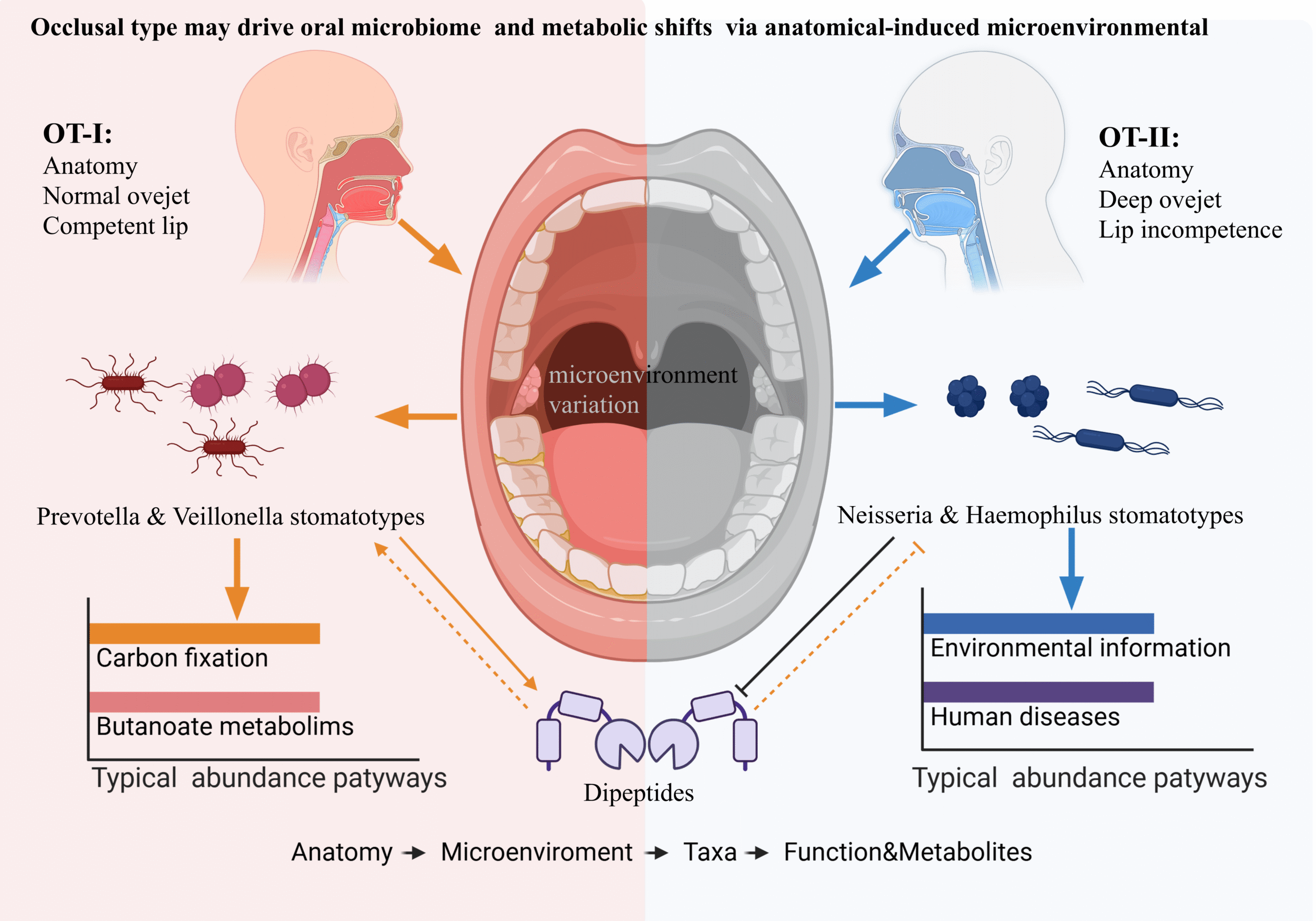
Occlusal types shape oral microbiome stomatotypes and metabolic landscapes: A multi-omics perspective on host-microbe interaction
Yufeng Duan1,a, Zheng Liu2,3,a, Wenting Lu1,a, Ning Zhao1, Lingjun Yuan1, Zhenxia Li1, Ting Zhou1, Shengzhao Xiao1, Dian Jing1, Xiaowen Zheng1, Wentao Shi4, Chao Liu1,*, Haixia Lu5,*, Qiang Feng6,* and Bing Fang1,*
This study reveals how occlusal types shape oral microbiome “stomatotypes” and metabolic profiles in adolescents. It offers fresh insights that host anatomy drives microecology which may be associated with personalized oral health.

Genomic epidemiology of carbapenemase-producing Klebsiella pneumoniae circulating in a Chilean tertiary-care hospital (2021–2022): Molecular characterization, resistance-virulence convergence, and clinical associations
Gustavo Araya1,2, Alhejandra Álvarez1, Carolina Arellano1, Rodrigo Bravo3, Abraham Gajardo4,5, Boris Barrera6, Francisco Silva6 and Roberto M. Vidal1
This study characterized carbapenem-resistant Kp (CR-Kp) strains isolated at the Hospital Clínico Universidad de Chile (HCUCH) 2021-2022 and explored associations with clinical characteristics.

Sugar-induced cell death (SICD) in Saccharomyces cerevisiae: insights into nitrogen-mediated rescue and apoptotic cell death pathways
Raveena Parbhudayal and Hai-Ping Cheng
This study examined mechanisms through which yeast sugar-induced cell death can be prevented. High concentrations of glucose induced a catastrophic response that was only rescued by highly preferred nitrogen sources and by preventing nuclear localization of specific cell death proteins.

TOR-dependent regulation of the yeast homolog of the juvenile Batten Disease-associated gene CLN3
Vijaykumar Pillalamarri1, Samuel W.M. Gatesy1, Amanda E. Grassel1, Lucienna Wolf1, Justin P. Whalley2 and David M. Mueller1,*
This study identifies conditions and genes that induce BTN1 expression in yeast. We show that BTN1 expression is regulated by translational control and by the mTOR1 pathway. An understanding of when and why BTN1 expression will aid in understanding the expression of CLN3, which may be helpful in the treatment of this devastating disease.

Metagenomic and microbiological analyses of historical manuscripts for bacterial community profiling and bacteria-related biodeterioration assessment
Esra Keles1,* and Ozge Celik2
By documenting both culturable and non-culturable taxa, this work provides a foundational dataset for understanding bacterial contributions to manuscript stability and offers a methodological framework for future research on biodeterioration dynamics in Islamic and global documentary heritage.

Overcoming phagocytosis resistance of hypervirulent Klebsiella pneumoniae by directly targeting capsules
Shogo Tsubaki1, Touya Toyomoto1, Rika Tanaka2,3, Jin Imai4,5, Juntaro Matsuzaki6,7, Katsuto Hozumi2 and Hitoshi Tsugawa1,5*
This study highlights a promising strategy for disarming hypervirulent K. pneumoniae by directly targeting its key virulence factors and provides novel insights into antibacterial therapeutic approaches against this clinically significant pathogen.

VapA/Scs2 sustains polarized growth in Aspergillus nidulans by maintaining AP-2-mediated apical endocytosis
Xenia Georgiou1, Sofia Politi1, Sotiris Amillis1 and George Diallinas1,2,*
To explore the functional significance of ER–PM contact sites in filamentous fungi, we identified and genetically characterized all Aspergillus nidulans proteins homologous to Snc2/VAP, Ist2, or tricalbins.

Genetic make-up and regulation of the L-lysine biosynthesis pathway in Vibrio natriegens
Elly Straube1, Johannes Radde1, Thi Van Anh Tran1, Negin Keihani Yazdi1, Rubén Crespo Blanco1, Ha Thanh Le2, Cláudio J.R. Frazão1 and Thomas Walther1,*
This study analysed the make-up and regulation of the biosynthetic pathway for L-lysine and related L-aspartate family amino acids (AFAAs) in Vibrio natriegens DSM759 to provide a comprehensive basis for future metabolic engineering endeavours aiming at developing this strain into an amino acid overproducer.

Regulation of extracellular vesicles for protein secretion in Aspergillus nidulans
Rebekkah E. Pope1, Patrick Ballmann2, Lisa Whitworth3 and Rolf A. Prade1,*
This study reveals that Aspergillus nidulans boosts extracellular vesicle production when ER-trafficked enzymes are induced, uncovering how fungi remodel their secretome through vesicle-mediated secretion to adapt to changing environments and biofilm formation.
A simple microfluidic platform to study age-dependent protein abundance and localization changes in Saccharomyces cerevisiae
April 13, 2017
We have developed a user-friendly microfluidic system paired with a genetic approach to enrich and study ageing mother yeast cells, enabling the monitoring of protein abundance and localization changes during the crucial first half of their replicative lifespan, leading to the discovery of novel age-dependent protein behaviors.
Thiol trapping and metabolic redistribution of sulfur metabolites enable cells to overcome cysteine overload
March 27, 2017
In this study, researchers investigate the mechanisms for handling cysteine overload using Saccharomyces cerevisiae, finding that overexpressing the high affinity cysteine transporter, YCT1, enables yeast cells to rapidly accumulate high levels of intracellular cysteine. The study demonstrates that cells can manage potentially toxic levels of cysteine by converting it to non-reactive thiol forms and utilizing the metabolic products for cell growth.
The frequency of yeast [PSI+] prion formation is increased during chronological ageing
March 27, 2017
Aging is marked by a decline in cellular functions and the increased formation of the yeast [PSI+] prion, an altered translation termination factor, which suggests that autophagy suppresses age-related prion development. Interestingly, yeast cells that adopt the [PSI+] form exhibit better survival through aging, indicating that [PSI+] formation, linked to enhanced autophagy, may confer advantages such as reduced protein aggregation and improved cell viability.
A multigene family encoding surface glycoproteins in Trypanosoma congolense
March 2, 2017
Trypanosoma congolense, the causative agent of the most important livestock disease in Africa, expresses specific surface proteins involved in its parasitic lifestyle. By mining the T. congolense genome database, we identified a novel family of lectin-like glycoproteins (TcoClecs).
Identification of Ftr1 and Zrt1 as iron and zinc micronutrient transceptors for activation of the PKA pathway in Saccharomyces cerevisiae
March 2, 2017
We now show that the yeast high-affinity iron transporter Ftr1 and high-affinity zinc transporter Zrt1 function as transceptors for the micronutrients iron and zinc. We show that replenishment of iron to iron-starved cells or zinc to zinc-starved cells triggers within 1-2 minutes a rapid surge in trehalase activity, a well-established PKA target.
Balanced CoQ6 biosynthesis is required for lifespan and mitophagy in yeast
February 3, 2017
In brief, we show that, in yeast, Ptc7 modulates the adaptation to respiratory metabolism by dephosphorylating Coq7 to supply newly synthesized CoQ6, and by activating mitophagy to remove defective mitochondria at stationary phase, guaranteeing a proper CLS in yeast.
Mutational analysis of fructose-1,6-bis-phosphatase FBP1 indicates partially independent functions in gluconeogenesis and sensitivity to genotoxic stress
February 1, 2017
Our results support predicted vital roles of several fructose-1,6-bisphosphatase residues for enzymatic activity and led to the identification of residues indispensable for the MMS-sensitizing effect. Despite an overlap between these two properties, careful analysis revealed two mutations, Asn75 and His324, which decouple the enzymatic activity and the MMS-sensitizing effect, indicating two distinctive biological activities linked in this key gluconeogenesis enzyme.
The copper transport-associated protein Ctr4 can form prion-like epigenetic determinants in Schizosaccharomyces pombe
January 2, 2017
Ctr4 exhibits multiple features diagnostic of other fungal prions and is the first example of a prion in fission yeast. These findings suggest that transmissible protein-based determinants of traits may be more widespread among fungi.
Improvement of biochemical methods of polyP quantification
December 29, 2016
As the main output of this evaluation we propose a straightforward and robust procedure that can be used as gold standard protocol for cellular polyP purification and determination from unicellular organisms, thus providing consistency to measurements and facilitating inter-laboratory comparisons and biological interpretation of the results.
Bax mitochondrial relocation is linked to its phosphorylation and its interaction with Bcl-xL
December 5, 2016
The heterologous expression of Bax, and other Bcl-2 family members, in the yeast Saccharomyces cerevisiae, has proved to be a valuable reporter system to investigate the molecular mechanisms underlying their interaction with mitochondria. Our data provide the molecular basis for a model of dynamic equilibrium for Bax localization and activation, regulated both by phosphorylation and Bcl-xL.