
Vol. 08, 2021
Landscapes and bacterial signatures of mucosa-associated intestinal microbiota in Chilean and Spanish patients with inflammatory bowel disease
Nayaret Chamorro1,#, David A. Montero1,2,#, Pablo Gallardo3, Mauricio Farfán3, Mauricio Contreras4, Marjorie De la Fuente2, Karen Dubois2, Marcela A. Hermoso2, Rodrigo Quera5,6, Marjorie Pizarro-Guajardo7,8,9, Daniel Paredes-Sabja7,8,9, Daniel Ginard10, Ramon Rosselló-Móra11 and Roberto Vidal1,8,12
This study investigates the landscapes and alterations of mucosa-associated intestinal microbiota in patients with inflammatory bowel diseases, which cause chronic inflammation of the gut, including ulcerative colitis and Crohn’s disease.
Genome, transcriptome and secretome analyses of the antagonistic, yeast-like fungus Aureobasidium pullulans to identify potential biocontrol genes
Maria Paula Rueda-Mejia1, Lukas Nägeli1, Stefanie Lutz2, Richard D. Hayes3, Adithi R. Varadarajan2, Igor V. Grigoriev3,4, Christian H. Ahrens2,5 and Florian M. Freimoser1
This study highlights the value of a sequential approach starting with genome mining and consecutive transcriptome and secretome analyses in order to identify a limited number of potential target genes for detailed, functional analyses in Aureobasidium pullulans.

LasR-regulated proteases in acute vs. chronic lung infection: a double-edged sword
Lisa C. Hennemann1,2 and Dao Nguyen1,2,3
This article comments on work published by Hennemann et al. (PLoS Pathog, 2021), which observed that in Pseudomonas aeruginosa, functional loss of the quorum sensing transcriptional activator LasR in lasR variants results in impaired secreted protease production, leads to increased expression of the membrane-bound surface adhesion molecule mICAM-1 in the airway epithelium, and increases neutrophilic inflammation.
DNA polymerase III protein, HolC, helps resolve replication/transcription conflicts
Susan T. Lovett1
This article comments on work published by Cooper et al. (mBio, 2021), which isolated and identified spontaneous suppressor mutants in a strain devoid of the holC gene, which encodes an accessory protein to the core clamp loader complex and is the only protein of the DNA polymerase III holoenzyme that binds to single-strand DNA binding protein.
Proanthocyanidin-enriched cranberry extract induces resilient bacterial community dynamics in a gnotobiotic mouse model
Catherine C. Neto1,2,#, Benedikt M. Mortzfeld3,#, John R. Turbitt1,2, Shakti K. Bhattarai3, Vladimir Yeliseyev4, Nicholas DiBenedetto4, Lynn Bry4 and Vanni Bucci2,3
This study investigates the effect of a water-soluble, proanthocyanidin-rich cranberry juice extract on the short-term dynamics of a human-derived bacterial community in a gnotobiotic mouse model.
Too much of a good thing: Overproduction of virulence factors impairs cryptococcal pathogenicity
Julia C. V. Reuwsaat1, Tamara L. Doering2, and Livia Kmetzsch1,3
This article comments on work published by Reuwsaat et al. (mBio, 2021), which identified the transcription factor Pdr802 as essential for Cryptococcus neoformans adaptation to and survival under host conditions both in vitro and in vivo.
Dry biocleaning of artwork: an innovative methodology for Cultural Heritage recovery?
Giancarlo Ranalli1, Pilar Bosch-Roig2, Simone Crudele1, Laura Rampazzi3,4, Cristina Corti3 and Elisabetta Zanardini5
This work proposes an innovative methodology based on applied biotechnology for the recovery of altered stonework: the "dry biocleaning", which envisages the use of dehydrated microbial cells without the use of free water or gel-based matrices.
Forced association of SARS-CoV-2 proteins with the yeast proteome perturb vesicle trafficking
Cinzia Klemm1,#, Henry Wood1,#, Grace Heredge Thomas1,#, Guðjón Ólafsson1,2, Mara Teixeira Torres1 and Peter H. Thorpe1
This work demonstrates that the yeast Synthetic Physical Interactions method is a rapid way to identify potential functions of ectopic viral proteins.
Lipid and fatty acid metabolism in trypanosomatids
Giovana Parreira de Aquino1,#, Marco Antonio Mendes Gomes1,#, Roberto Köpke Salinas2 and Maria Fernanda Laranjeira-Silva1
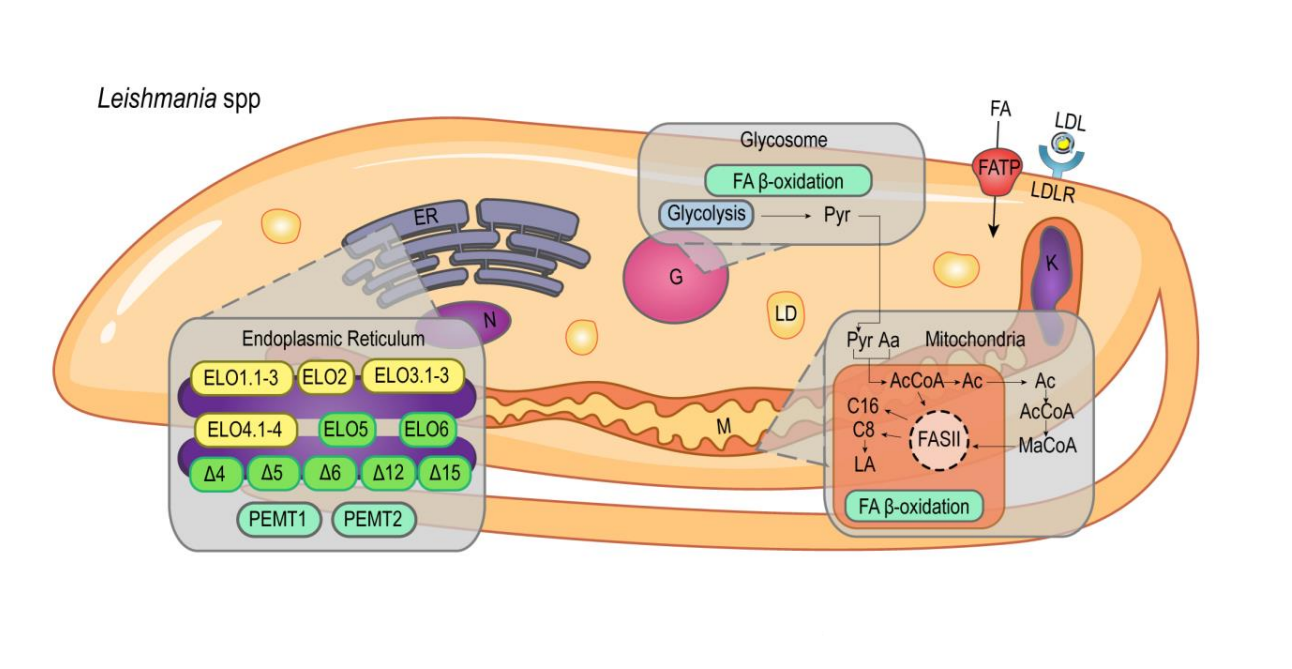
This work reviews specific aspects of lipid and fatty acid metabolism in the protozoan parasites T. brucei, T. cruzi, and Leishmania spp., as well as the pathways that have been explored for the development of new chemotherapies.
Urm1, not quite a ubiquitin-like modifier?
Lars Kaduhr1, Cindy Brachmann1, Keerthiraju Ethiraju Ravichandran2,3, James D. West4, Sebastian Glatt2 and Raffael Schaffrath1
This article comments on work published by Brachmann et al. (Redox Biol, 2020), which studied urmylation of the yeast 2-Cys peroxiredoxin Ahp1, uncovering that promiscuous lysine target sites and specific redox requirements determine the Urm1 acceptor activity of the peroxiredoxin.

Using microbial metalo-aminopeptidases as targets in human infectious diseases
Jorge González-Bacerio1,2, Maikel Izquierdo1, Mirtha Elisa Aguado1, Ana C. Varela1, Maikel González-Matos1 and Maday Alonso del Rivero1
This Review highlights the relevant roles of microbial metalo-aminopeptidases in bacteria and protozoa that could be targeted for therapeutic purposes.
The long and winding road of reverse genetics in Trypanosoma cruzi
Miguel A. Chiurillo1 and Noelia Lander1
This Editorial provides a brief historic overview that highlights the strengths and weaknesses of the molecular strategies that have been developed to genetically modify Trypanosoma cruzi, emphasizing the future directions of the field.
Lipid and fatty acid metabolism in trypanosomatids
Giovana Parreira de Aquino1,#, Marco Antonio Mendes Gomes1,#, Roberto Köpke Salinas2 and Maria Fernanda Laranjeira-Silva1
This work reviews specific aspects of lipid and fatty acid metabolism in the protozoan parasites T. brucei, T. cruzi, and Leishmania spp., as well as the pathways that have been explored for the development of new chemotherapies.
Using microbial metalo-aminopeptidases as targets in human infectious diseases
Jorge González-Bacerio1,2, Maikel Izquierdo1, Mirtha Elisa Aguado1, Ana C. Varela1, Maikel González-Matos1 and Maday Alonso del Rivero1
This Review highlights the relevant roles of microbial metalo-aminopeptidases in bacteria and protozoa that could be targeted for therapeutic purposes.

Understanding the pathogenesis of infectious diseases by single-cell RNA sequencing
Wanqiu Huang1, Danni Wang1 and Yu-Feng Yao1,2
This work highlights recent remarkable advances in single-cell RNA sequencing technologies and their applications in the investigation of host-pathogen interactions. Current challenges and potential prospects for disease treatment are discussed as well.

Exploring absent protein function in yeast: assaying post translational modification and human genetic variation
Christina S. Moesslacher1,#, Johanna M. Kohlmayr1,# and Ulrich Stelzl1,#
This review discusses the applicability of yeast systems to investigate absent human protein function with a specific focus on the impact of protein variation on protein-protein interaction modulation.
LasR-regulated proteases in acute vs. chronic lung infection: a double-edged sword
Lisa C. Hennemann1,2 and Dao Nguyen1,2,3
This article comments on work published by Hennemann et al. (PLoS Pathog, 2021), which observed that in Pseudomonas aeruginosa, functional loss of the quorum sensing transcriptional activator LasR in lasR variants results in impaired secreted protease production, leads to increased expression of the membrane-bound surface adhesion molecule mICAM-1 in the airway epithelium, and increases neutrophilic inflammation.
DNA polymerase III protein, HolC, helps resolve replication/transcription conflicts
Susan T. Lovett1
This article comments on work published by Cooper et al. (mBio, 2021), which isolated and identified spontaneous suppressor mutants in a strain devoid of the holC gene, which encodes an accessory protein to the core clamp loader complex and is the only protein of the DNA polymerase III holoenzyme that binds to single-strand DNA binding protein.
Too much of a good thing: Overproduction of virulence factors impairs cryptococcal pathogenicity
Julia C. V. Reuwsaat1, Tamara L. Doering2, and Livia Kmetzsch1,3
This article comments on work published by Reuwsaat et al. (mBio, 2021), which identified the transcription factor Pdr802 as essential for Cryptococcus neoformans adaptation to and survival under host conditions both in vitro and in vivo.
Mechanisms underlying lactic acid tolerance and its influence on lactic acid production in Saccharomyces cerevisiae
Arne Peetermans1,2, María R. Foulquié-Moreno1,2 and Johan M. Thevelein1,2,3
This article reviews the manner in which Saccharomyces cerevisiae deals with the accumulation of lactic acid as a singular stress factor as well as in combination with other stresses. In addition, different methods to improve lactic acid tolerance in S. cerevisiae using targeted and non-targeted engineering methods are discussed.
Murals meet microbes: at the crossroads of microbiology and cultural heritage
Maria A. Bauer1, Katharina Kainz1, Christoph Ruckenstuhl1, Frank Madeo1-3 and Didac Carmona-Gutierrez1
This article comments on the duality of microorganisms in the conservation and restoration of cultural heritage, which encompasses the negative impact of damaging microorganisms and recent advances in using specific microorganisms and microbial-based technologies for cultural heritage preservation.
Urm1, not quite a ubiquitin-like modifier?
Lars Kaduhr1, Cindy Brachmann1, Keerthiraju Ethiraju Ravichandran2,3, James D. West4, Sebastian Glatt2 and Raffael Schaffrath1
This article comments on work published by Brachmann et al. (Redox Biol, 2020), which studied urmylation of the yeast 2-Cys peroxiredoxin Ahp1, uncovering that promiscuous lysine target sites and specific redox requirements determine the Urm1 acceptor activity of the peroxiredoxin.
The long and winding road of reverse genetics in Trypanosoma cruzi
Miguel A. Chiurillo1 and Noelia Lander1
This Editorial provides a brief historic overview that highlights the strengths and weaknesses of the molecular strategies that have been developed to genetically modify Trypanosoma cruzi, emphasizing the future directions of the field.
Means of intracellular communication: touching, kissing, fusing
Anne Spang1
This work highlights different aspects of communication between organelles, including the importance of organellar contact sites.
Neuropathogenesis caused by Trypanosoma brucei, still an enigma to be unveiled
Katherine Figarella1
This Editorial addresses the meningo-encephalitic stage of Trypanosoma brucei infection and the resultig neuropathogenesis as well as the impact that the application of tools developed in the last years in the field of neuroscience will have on the study of neglected tropical diseases.
Lichens – growing greenhouses en miniature
Martin Grube1
This commentary article provides an overview on different aspects of lichen biology and the remarkable symbiotic association between fungi and algae.
Murals meet microbes: at the crossroads of microbiology and cultural heritage
December 6, 2021
This article comments on the duality of microorganisms in the conservation and restoration of cultural heritage, which encompasses the negative impact of damaging microorganisms and recent advances in using specific microorganisms and microbial-based technologies for cultural heritage preservation.
Forced association of SARS-CoV-2 proteins with the yeast proteome perturb vesicle trafficking
October 27, 2021
This work demonstrates that the yeast Synthetic Physical Interactions method is a rapid way to identify potential functions of ectopic viral proteins.
Lipid and fatty acid metabolism in trypanosomatids
October 6, 2021
This work reviews specific aspects of lipid and fatty acid metabolism in the protozoan parasites T. brucei, T. cruzi, and Leishmania spp., as well as the pathways that have been explored for the development of new chemotherapies.
Urm1, not quite a ubiquitin-like modifier?
September 21, 2021
This article comments on work published by Brachmann et al. (Redox Biol, 2020), which studied urmylation of the yeast 2-Cys peroxiredoxin Ahp1, uncovering that promiscuous lysine target sites and specific redox requirements determine the Urm1 acceptor activity of the peroxiredoxin.
The long and winding road of reverse genetics in Trypanosoma cruzi
August 5, 2021
This Editorial provides a brief historic overview that highlights the strengths and weaknesses of the molecular strategies that have been developed to genetically modify Trypanosoma cruzi, emphasizing the future directions of the field.
Understanding the pathogenesis of infectious diseases by single-cell RNA sequencing
August 4, 2021
This work highlights recent remarkable advances in single-cell RNA sequencing technologies and their applications in the investigation of host-pathogen interactions. Current challenges and potential prospects for disease treatment are discussed as well.
Airborne bacteria in show caves from Southern Spain
July 26, 2021
This study analyzes the factors conditioning the diversity of airborne bacteria recorded in three Andalusian show caves, subjected to different managements.
Exploring absent protein function in yeast: assaying post translational modification and human genetic variation
July 2, 2021
This review discusses the applicability of yeast systems to investigate absent human protein function with a specific focus on the impact of protein variation on protein-protein interaction modulation.
Landscapes and bacterial signatures of mucosa-associated intestinal microbiota in Chilean and Spanish patients with inflammatory bowel disease
June 18, 2021
This study investigates the landscapes and alterations of mucosa-associated intestinal microbiota in patients with inflammatory bowel diseases, which cause chronic inflammation of the gut, including ulcerative colitis and Crohn’s disease.
Murals meet microbes: at the crossroads of microbiology and cultural heritage
Maria A. Bauer1, Katharina Kainz1, Christoph Ruckenstuhl1, Frank Madeo1-3 and Didac Carmona-Gutierrez1
This article comments on the duality of microorganisms in the conservation and restoration of cultural heritage, which encompasses the negative impact of damaging microorganisms and recent advances in using specific microorganisms and microbial-based technologies for cultural heritage preservation.