
Vol. 08, 2021
Nutrient sensing and cAMP signaling in yeast: G-protein coupled receptor versus transceptor activation of PKA
Griet Van Zeebroeck1,2,†, Liesbeth Demuyser1,2,†, Zhiqiang Zhang1,2, Ines Cottignie1,2 and Johan M. Thevelein1,2
The herein presented work supports a model, in which nutrient transceptors are evolutionary ancestors of GPCRs, employing a more primitive direct signaling mechanism compared to the indirect cAMP second-messenger signaling mechanism used by GPCRs for activation of PKA.
Forced association of SARS-CoV-2 proteins with the yeast proteome perturb vesicle trafficking
Cinzia Klemm1,#, Henry Wood1,#, Grace Heredge Thomas1,#, Guðjón Ólafsson1,2, Mara Teixeira Torres1 and Peter H. Thorpe1
This work demonstrates that the yeast Synthetic Physical Interactions method is a rapid way to identify potential functions of ectopic viral proteins.
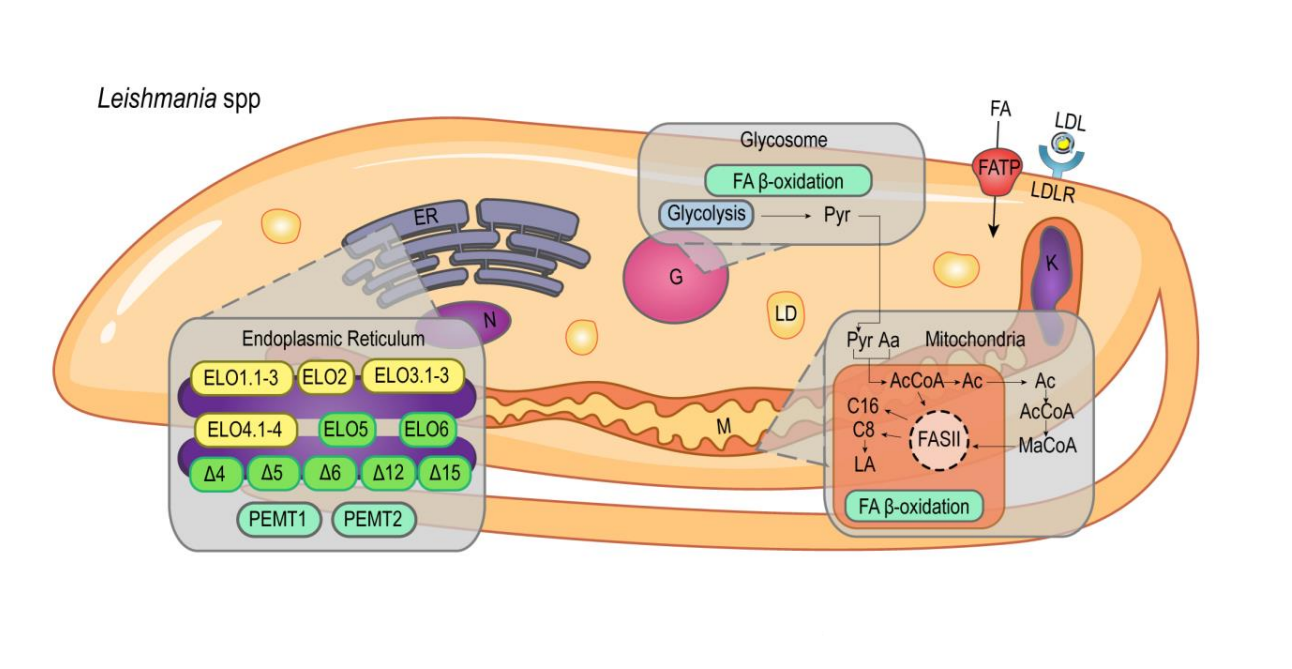
Lipid and fatty acid metabolism in trypanosomatids
Giovana Parreira de Aquino1,#, Marco Antonio Mendes Gomes1,#, Roberto Köpke Salinas2 and Maria Fernanda Laranjeira-Silva1
This work reviews specific aspects of lipid and fatty acid metabolism in the protozoan parasites T. brucei, T. cruzi, and Leishmania spp., as well as the pathways that have been explored for the development of new chemotherapies.
Urm1, not quite a ubiquitin-like modifier?
Lars Kaduhr1, Cindy Brachmann1, Keerthiraju Ethiraju Ravichandran2,3, James D. West4, Sebastian Glatt2 and Raffael Schaffrath1
This article comments on work published by Brachmann et al. (Redox Biol, 2020), which studied urmylation of the yeast 2-Cys peroxiredoxin Ahp1, uncovering that promiscuous lysine target sites and specific redox requirements determine the Urm1 acceptor activity of the peroxiredoxin.

Using microbial metalo-aminopeptidases as targets in human infectious diseases
Jorge González-Bacerio1,2, Maikel Izquierdo1, Mirtha Elisa Aguado1, Ana C. Varela1, Maikel González-Matos1 and Maday Alonso del Rivero1
This Review highlights the relevant roles of microbial metalo-aminopeptidases in bacteria and protozoa that could be targeted for therapeutic purposes.
The long and winding road of reverse genetics in Trypanosoma cruzi
Miguel A. Chiurillo1 and Noelia Lander1
This Editorial provides a brief historic overview that highlights the strengths and weaknesses of the molecular strategies that have been developed to genetically modify Trypanosoma cruzi, emphasizing the future directions of the field.
When the pandemic opts for the lockdown: Secretion system evolution in the cholera bacterium
Francis J. Santoriello1,2 and Stefan Pukatzki1,2
This article comments on work published by Santoriello et al. (Nat Comm, 2020), which demonstrates that the T6SS island Auxiliary Cluster 3 (Aux3) is unique to pandemic strains of V. cholerae.
Biofilms by bacterial human pathogens: Clinical relevance – development, composition and regulation – therapeutical strategies
Adina Schulze1,#, Fabian Mitterer1,#, Joao P. Pombo1 and Stefan Schild1,2,3
This review focuses on bacterial biofilms formed by human pathogens, highlights their relevance for diverse diseases and discusses therapeutical intervention strategies targeting biofilms.
Milestones in Bacillus subtilis sporulation research
Eammon P. Riley1, Corinna Schwarz2, Alan I. Derman2 and Javier Lopez-Garrido2
In this review, the foundational discoveries that shaped the sporulation field are discussed, from its origins to the present day, tracing a chronology that spans more than one hundred eighty years.
Murals meet microbes: at the crossroads of microbiology and cultural heritage
Maria A. Bauer1, Katharina Kainz1, Christoph Ruckenstuhl1, Frank Madeo1-3 and Didac Carmona-Gutierrez1
This article comments on the duality of microorganisms in the conservation and restoration of cultural heritage, which encompasses the negative impact of damaging microorganisms and recent advances in using specific microorganisms and microbial-based technologies for cultural heritage preservation.
Urm1, not quite a ubiquitin-like modifier?
Lars Kaduhr1, Cindy Brachmann1, Keerthiraju Ethiraju Ravichandran2,3, James D. West4, Sebastian Glatt2 and Raffael Schaffrath1
This article comments on work published by Brachmann et al. (Redox Biol, 2020), which studied urmylation of the yeast 2-Cys peroxiredoxin Ahp1, uncovering that promiscuous lysine target sites and specific redox requirements determine the Urm1 acceptor activity of the peroxiredoxin.
The long and winding road of reverse genetics in Trypanosoma cruzi
Miguel A. Chiurillo1 and Noelia Lander1
This Editorial provides a brief historic overview that highlights the strengths and weaknesses of the molecular strategies that have been developed to genetically modify Trypanosoma cruzi, emphasizing the future directions of the field.
Means of intracellular communication: touching, kissing, fusing
Anne Spang1
This work highlights different aspects of communication between organelles, including the importance of organellar contact sites.
Neuropathogenesis caused by Trypanosoma brucei, still an enigma to be unveiled
Katherine Figarella1
This Editorial addresses the meningo-encephalitic stage of Trypanosoma brucei infection and the resultig neuropathogenesis as well as the impact that the application of tools developed in the last years in the field of neuroscience will have on the study of neglected tropical diseases.
Lichens – growing greenhouses en miniature
Martin Grube1
This commentary article provides an overview on different aspects of lichen biology and the remarkable symbiotic association between fungi and algae.
Genome, transcriptome and secretome analyses of the antagonistic, yeast-like fungus Aureobasidium pullulans to identify potential biocontrol genes
June 8, 2021
This study highlights the value of a sequential approach starting with genome mining and consecutive transcriptome and secretome analyses in order to identify a limited number of potential target genes for detailed, functional analyses in Aureobasidium pullulans.
LasR-regulated proteases in acute vs. chronic lung infection: a double-edged sword
May 31, 2021
This article comments on work published by Hennemann et al. (PLoS Pathog, 2021), which observed that in Pseudomonas aeruginosa, functional loss of the quorum sensing transcriptional activator LasR in lasR variants results in impaired secreted protease production, leads to increased expression of the membrane-bound surface adhesion molecule mICAM-1 in the airway epithelium, and increases neutrophilic inflammation.
DNA polymerase III protein, HolC, helps resolve replication/transcription conflicts
May 6, 2021
This article comments on work published by Cooper et al. (mBio, 2021), which isolated and identified spontaneous suppressor mutants in a strain devoid of the holC gene, which encodes an accessory protein to the core clamp loader complex and is the only protein of the DNA polymerase III holoenzyme that binds to single-strand DNA binding protein.
Proanthocyanidin-enriched cranberry extract induces resilient bacterial community dynamics in a gnotobiotic mouse model
April 29, 2021
This study investigates the effect of a water-soluble, proanthocyanidin-rich cranberry juice extract on the short-term dynamics of a human-derived bacterial community in a gnotobiotic mouse model.
Too much of a good thing: Overproduction of virulence factors impairs cryptococcal pathogenicity
April 20, 2021
This article comments on work published by Reuwsaat et al. (mBio, 2021), which identified the transcription factor Pdr802 as essential for Cryptococcus neoformans adaptation to and survival under host conditions both in vitro and in vivo.
Dry biocleaning of artwork: an innovative methodology for Cultural Heritage recovery?
April 15, 2021
This work proposes an innovative methodology based on applied biotechnology for the recovery of altered stonework: the "dry biocleaning", which envisages the use of dehydrated microbial cells without the use of free water or gel-based matrices.
Mechanisms underlying lactic acid tolerance and its influence on lactic acid production in Saccharomyces cerevisiae
April 14, 2021
This article reviews the manner in which Saccharomyces cerevisiae deals with the accumulation of lactic acid as a singular stress factor as well as in combination with other stresses. In addition, different methods to improve lactic acid tolerance in S. cerevisiae using targeted and non-targeted engineering methods are discussed.
Means of intracellular communication: touching, kissing, fusing
April 13, 2021
This work highlights different aspects of communication between organelles, including the importance of organellar contact sites.
Murals meet microbes: at the crossroads of microbiology and cultural heritage
Maria A. Bauer1, Katharina Kainz1, Christoph Ruckenstuhl1, Frank Madeo1-3 and Didac Carmona-Gutierrez1
This article comments on the duality of microorganisms in the conservation and restoration of cultural heritage, which encompasses the negative impact of damaging microorganisms and recent advances in using specific microorganisms and microbial-based technologies for cultural heritage preservation.