
Reviews

Infinity war: Trichomonas vaginalis and interactions with host immune response
Giulia Bongiorni Galego1 and Tiana Tasca1
Trichomonas vaginalis is the pathological agent of human trichomoniasis with an incidence of 156 million cases worldwide. This review highlights parasite strategies to activate and stimulate or evade variated and complex immunological mechanisms related to the symptoms and clinical complications observed here.

The metabolites of lactic acid bacteria: classification, biosynthesis and modulation of gut microbiota
Huang Tang1,2, Wanqiu Huang1,2 and Yu-Feng Yao1,2,3,4,5
Lactic acid bacteria (LAB) are ubiquitous microorganisms that can colonize the intestine and participate in the physiological metabolism of the host. In this review, we summarize the metabolites of LAB and their influence on the intestine as well as the underlying regulatory mechanisms and their impact on human health.
Effects of the intestinal microbiota on prostate cancer treatment by androgen deprivation therapy
Safae Terrisse1, Laurence Zitvogel2-5 and Guido Kroemer6-8
Prostate cancer (PC) can be kept in check by androgen deprivation therapy (ADT, usually with the androgen synthesis inhibitor abiraterone acetate or the androgen receptor antagonist such as enzalutamide) until the tumor evolves to castration-resistant prostate cancer (CRPC). The transition of hormone-sensitive PC (HSPC) to CPRC has been explained by cancer cell-intrinsic resistance mechanisms. Recent data indicate that this transition is also marked by cancer cell-extrinsic mechanisms such as the failure of ADT-induced PC immunosurveillance, which depends on the presence of immunostimulatory bacteria in the gut. Moreover, intestinal bacteria that degrade drugs used for ADT, as well as bacteria that produce androgens, can interfere with the efficacy of ADT. Thus, specific bacteria in the gut serve as a source of testosterone, which accelerates prostate cancer progression, and men with CRPC exhibit an increased abundance of such bacteria with androgenic functions. In conclusion, the response of PC to ADT is profoundly influenced by the composition of the microbiota with its immunostimulatory, immunosuppressive and directly ADT-subversive elements.
Occurrence and potential mechanism of holin-mediated non-lytic protein translocation in bacteria
Thomas Brüser1 and Denise Mehner-Breitfeld1
Holins are generally believed to generate large membrane lesions that permit the passage of endolysins across the cytoplasmic membrane of prokaryotes, ultimately resulting in cell wall degradation and cell lysis. However, there are more and more examples known for non-lytic holin-dependent secretion of proteins by bacteria, indicating that holins somehow can transport proteins without causing large membrane lesions. Phage-derived holins can be used for a non-lytic endolysin translocation to permeabilize the cell wall for the passage of secreted proteins. In addition, clostridia, which do not possess the Tat pathway for transport of folded proteins, most likely employ non-lytic holin-mediated transport also for secretion of toxins and bacteriocins that are incompatible with the general Sec pathway. The mechanism for non-lytic holin-mediated transport is (...)
Pirates of the haemoglobin
Daniel Akinbosede1, Robert Chizea1 and Stephen A. Hare1,†
Not all treasure is silver and gold; for pathogenic bacteria, iron is the most precious and the most pillaged of metallic elements. Iron is essential for the survival and growth of all life; however free iron is scarce for bacteria inside human hosts. As a mechanism of defence, humans have evolved ways to store iron so as to render it inaccessible for invading pathogens, such as keeping the metal bound to iron-carrying proteins. For bacteria to survive within humans, they must therefore evolve counters to this defence to compete with these proteins for iron binding, or directly steal iron from them. (...)
Endomembrane remodeling and dynamics in Salmonella infection
Ziyan Fang1 and Stéphane Méresse1
Salmonellae are bacteria that cause moderate to severe infections in humans, depending on the strain and the immune status of the infected host. These pathogens have the particularity of residing in the cells of the infected host. They are usually found in a vacuolar compartment that the bacteria shape with the help of effector proteins. Following invasion of a eukaryotic cell, the bacterial vacuole undergoes maturation characterized by changes in localization, composition and morphology. In particular, membrane tubules stretching over the microtubule cytoskeleton are formed from the bacterial vacuole. Although these tubules do not occur in all infected cells, they are functionally important and promote intracellular replication. This review focuses on the role and significance of membrane compartment remodeling observed in infected cells and the bacterial and host cell pathways involved.
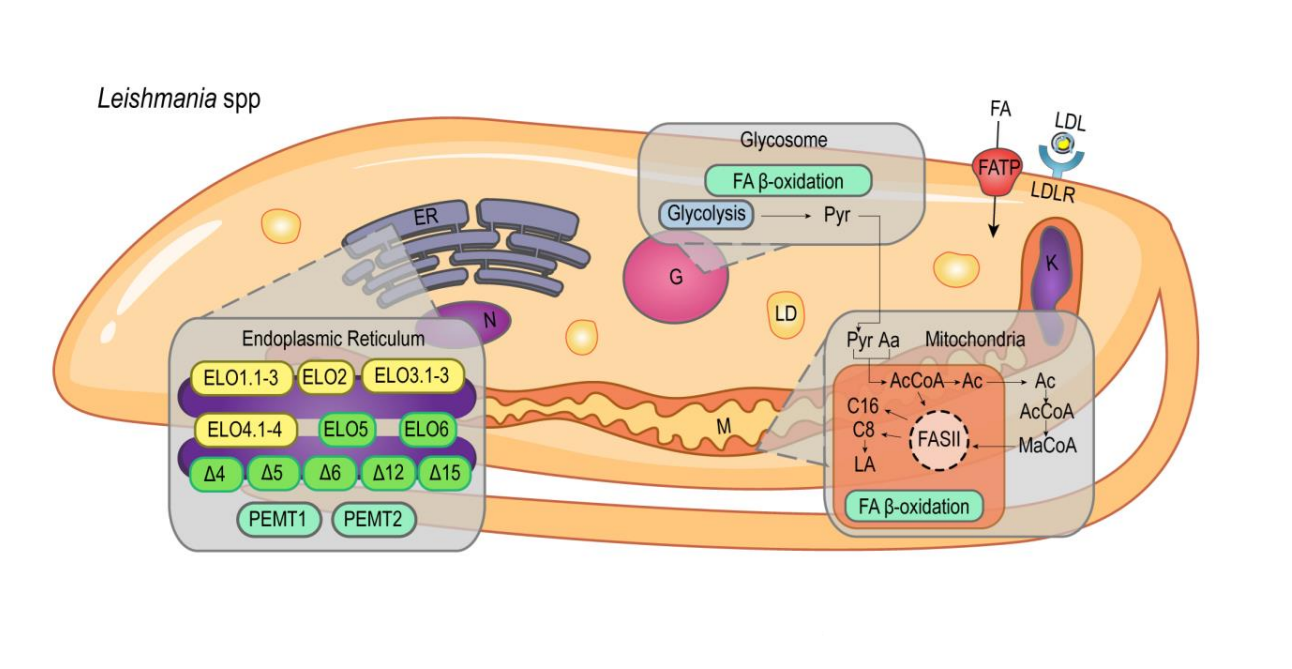
Lipid and fatty acid metabolism in trypanosomatids
Giovana Parreira de Aquino1,#, Marco Antonio Mendes Gomes1,#, Roberto Köpke Salinas2 and Maria Fernanda Laranjeira-Silva1
This work reviews specific aspects of lipid and fatty acid metabolism in the protozoan parasites T. brucei, T. cruzi, and Leishmania spp., as well as the pathways that have been explored for the development of new chemotherapies.

Using microbial metalo-aminopeptidases as targets in human infectious diseases
Jorge González-Bacerio1,2, Maikel Izquierdo1, Mirtha Elisa Aguado1, Ana C. Varela1, Maikel González-Matos1 and Maday Alonso del Rivero1
This Review highlights the relevant roles of microbial metalo-aminopeptidases in bacteria and protozoa that could be targeted for therapeutic purposes.

Understanding the pathogenesis of infectious diseases by single-cell RNA sequencing
Wanqiu Huang1, Danni Wang1 and Yu-Feng Yao1,2
This work highlights recent remarkable advances in single-cell RNA sequencing technologies and their applications in the investigation of host-pathogen interactions. Current challenges and potential prospects for disease treatment are discussed as well.
From the baker to the bedside: yeast models of Parkinson’s disease
July 27, 2015
The baker’s yeast Saccharomyces cerevisiae has been extensively explored for our understanding of fundamental cell biology processes highly conserved in the eukaryotic kingdom. This review provides a brief historical perspective on the emergence of yeast as an experimental model and on how the field evolved to exploit the potential of the model for tackling the intricacies of various human diseases. In particular, the authors focus on existing yeast models of the molecular underpinnings of Parkinson’s disease (PD), focusing primarily on the central role of protein quality control systems.
Why are essential genes essential? – The essentiality of Saccharomyces genes
July 25, 2015
Essential genes are defined as required for the survival of an organism or a cell. This article reviews and analyzes the levels of essentiality of the Saccharomyces cerevisiae genes and groups the genes into four categories: (1) Conditional essential: essential only under certain circumstances or growth conditions; (2) Essential: required for survival under optimal growth conditions; (3) Redundant essential: synthetic lethal due to redundant pathways or gene duplication; and (4) Absolute essential: the minimal genes required for maintaining a cellular life under a stress-free environment. The essential and non-essential functions of the essential genes are further analyzed.
Membrane depolarization-triggered responsive diversification leads to antibiotic tolerance
July 24, 2015
In this article, the authors discuss the article "Obg and membrane depolarization are part of a microbial bet-hedging strategy that leads to antibiotic tolerance", Verstraeten et al., Mol. Cell 2015 Jul 2; 59 (1): 9-21.
Evolutionary rewiring of bacterial regulatory networks
July 6, 2015
Bacteria have evolved complex regulatory networks that enable integration of multiple intracellular and extracellular signals to coordinate responses to environmental changes. However, our knowledge of how regulatory systems function and evolve is still relatively limited. There is often extensive homology between components of different networks, due to past cycles of gene duplication, divergence, and horizontal gene transfer, raising the possibility of cross-talk or redundancy. Consequently, evolutionary resilience is built into gene networks – homology between regulators can potentially allow rapid rescue of lost regulatory function across distant regions of the genome. This article discusses Taylor, et al. Science (2015), 347(6225), reporting mutations that facilitate cross-talk between pathways can contribute to gene network evolution, but which come with severe pleiotropic costs. Arising from this work are a number of questions surrounding how this phenomenon occurs.
Wanted Plasmodium falciparum, dead or alive
June 23, 2015
In this article, mechanisms of cell death in unicellular parasites are discussed, focussing on “programmed cell death” in Plasmodium.
Yeast as a tool to explore cathepsin D function
June 11, 2015
Cathepsin D has garnered increased attention in recent years, mainly since it has been associated with several human pathologies. This review summarizes how cathepsin D can have both anti- and pro-survival functions depending on its proteolytic activity, cellular context and stress stimulus.
Coordinate responses to alkaline pH stress in budding yeast
May 22, 2015
This review summarizes the modulation of a substantial number of signaling pathways whose participate in the alkaline response in yeast. These regulatory inputs involve not only the conserved Rim101/PacC pathway, but also the calcium-activated phosphatase calcineurin, the Wsc1-Pkc1-Slt2 MAP kinase, the Snf1 and PKA kinases and oxidative stress-response pathways.
Handcuffs for bacteria – NDP52 orchestrates xenophagy of intracellular Salmonella
May 21, 2015
This microreview discusses the article "Autophagy Receptor NDP52 Regulates Pathogen-Containing Autophagosome Maturation" by Verlhac et al. (2015), Cell Host Microbe.
Understanding grapevine-microbiome interactions: implications for viticulture industry
May 4, 2015
This microreview discusses the article "The soil microbiome influences grapevine-associated microbiota" by Zarraonaindia et al. (2015), MBio, which reports that the grapevine-associated microbiota depends on the soil microbiome.