
Microreviews, Review
Pirates of the haemoglobin
Daniel Akinbosede1, Robert Chizea1 and Stephen A. Hare1,†
Not all treasure is silver and gold; for pathogenic bacteria, iron is the most precious and the most pillaged of metallic elements. Iron is essential for the survival and growth of all life; however free iron is scarce for bacteria inside human hosts. As a mechanism of defence, humans have evolved ways to store iron so as to render it inaccessible for invading pathogens, such as keeping the metal bound to iron-carrying proteins. For bacteria to survive within humans, they must therefore evolve counters to this defence to compete with these proteins for iron binding, or directly steal iron from them. (...)
An ionophore breaks the multi-drug-resistance of Acinetobacter baumannii
David M.P. De Oliveira1 and Mark J. Walker1
Within intensive care units, multi-drug resistant Acinetobacter baumannii outbreaks are a frequent cause of ventilator-associated pneumonia. During the on-going COVID-19 pandemic, patients who receive ventilator support experience a 2-fold increased risk of mortality when they contract a secondary A. baumannii pulmonary infection. In our recent paper (De Oliveira et al. (2022), Mbio, doi: 10.1128/mbio.03517-21), we demonstrate that the 8-hydroxquinoline ionophore, PBT2 breaks the resistance of A. baumannii to tetracycline class antibiotics. In vitro, the combination of PBT2 and zinc with either tetracycline, doxycycline, or tigecycline was shown to be bactericidal against multi-drug-resistant A. baumannii, (...)
Endomembrane remodeling and dynamics in Salmonella infection
Ziyan Fang1 and Stéphane Méresse1
Salmonellae are bacteria that cause moderate to severe infections in humans, depending on the strain and the immune status of the infected host. These pathogens have the particularity of residing in the cells of the infected host. They are usually found in a vacuolar compartment that the bacteria shape with the help of effector proteins. Following invasion of a eukaryotic cell, the bacterial vacuole undergoes maturation characterized by changes in localization, composition and morphology. In particular, membrane tubules stretching over the microtubule cytoskeleton are formed from the bacterial vacuole. Although these tubules do not occur in all infected cells, they are functionally important and promote intracellular replication. This review focuses on the role and significance of membrane compartment remodeling observed in infected cells and the bacterial and host cell pathways involved.
The small bowel microbiome changes significantly with age and aspects of the ageing process
Gabriela Leite1, Mark Pimentel1,2, Gillian M. Barlow1 and Ruchi Mathur1,3
Gut microbiome changes have been associated with human ageing and implicated in age-related diseases including Alzheimer’s disease and Parkinson’s disease. However, studies to date have used stool samples, which do not represent the entire gut. Although more challenging to access, the small intestine plays critical roles in host metabolism and immune function. In this paper (Leite et al. (2021), Cell Reports, doi: 10.1016/j.celrep.2021.109765), we demonstrate significant differences in the small intestinal microbiome in older subjects, (...)
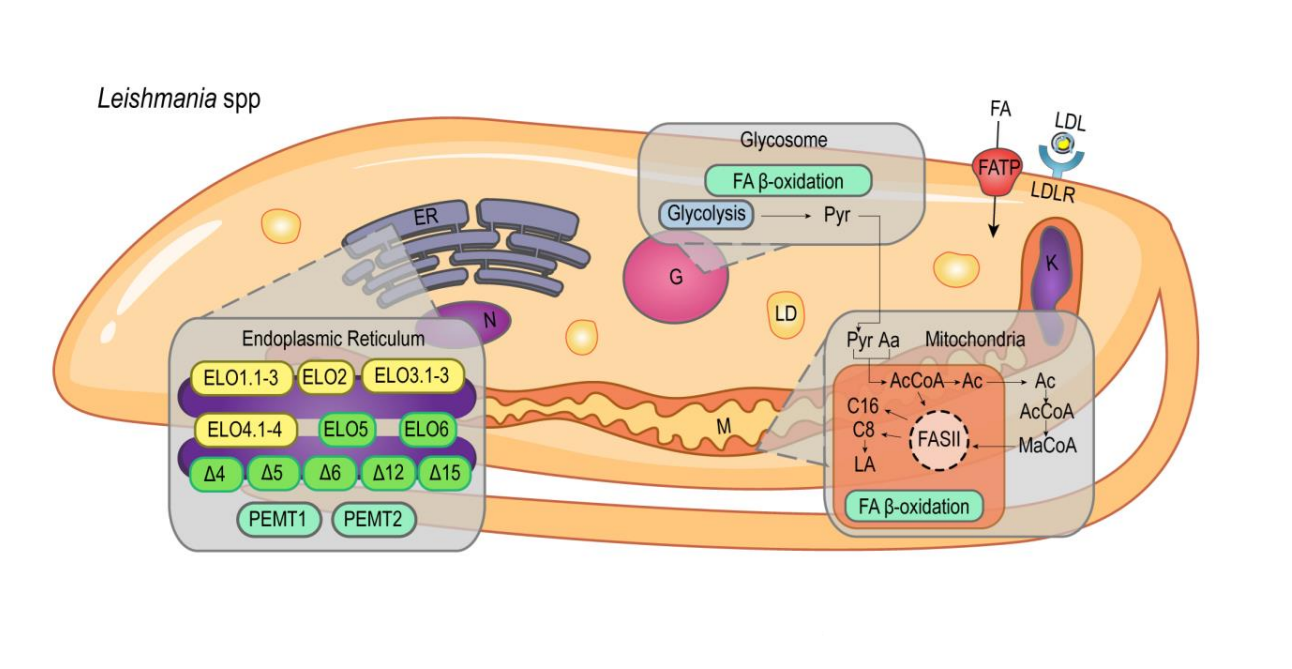
Lipid and fatty acid metabolism in trypanosomatids
Giovana Parreira de Aquino1,#, Marco Antonio Mendes Gomes1,#, Roberto Köpke Salinas2 and Maria Fernanda Laranjeira-Silva1
This work reviews specific aspects of lipid and fatty acid metabolism in the protozoan parasites T. brucei, T. cruzi, and Leishmania spp., as well as the pathways that have been explored for the development of new chemotherapies.

Using microbial metalo-aminopeptidases as targets in human infectious diseases
Jorge González-Bacerio1,2, Maikel Izquierdo1, Mirtha Elisa Aguado1, Ana C. Varela1, Maikel González-Matos1 and Maday Alonso del Rivero1
This Review highlights the relevant roles of microbial metalo-aminopeptidases in bacteria and protozoa that could be targeted for therapeutic purposes.

Understanding the pathogenesis of infectious diseases by single-cell RNA sequencing
Wanqiu Huang1, Danni Wang1 and Yu-Feng Yao1,2
This work highlights recent remarkable advances in single-cell RNA sequencing technologies and their applications in the investigation of host-pathogen interactions. Current challenges and potential prospects for disease treatment are discussed as well.

Exploring absent protein function in yeast: assaying post translational modification and human genetic variation
Christina S. Moesslacher1,#, Johanna M. Kohlmayr1,# and Ulrich Stelzl1,#
This review discusses the applicability of yeast systems to investigate absent human protein function with a specific focus on the impact of protein variation on protein-protein interaction modulation.

LasR-regulated proteases in acute vs. chronic lung infection: a double-edged sword
Lisa C. Hennemann1,2 and Dao Nguyen1,2,3
This article comments on work published by Hennemann et al. (PLoS Pathog, 2021), which observed that in Pseudomonas aeruginosa, functional loss of the quorum sensing transcriptional activator LasR in lasR variants results in impaired secreted protease production, leads to increased expression of the membrane-bound surface adhesion molecule mICAM-1 in the airway epithelium, and increases neutrophilic inflammation.
The replication timing program in the hands of two HDACs
July 25, 2014
This article comments on work published by Yoshida et al. (Mol Cell, 2014), which performed a systematic analysis of the role of histone deacetylases (HDACs) in the regulation of origin activity in budding yeast, finding that the epigenetic regulation of repetitive sequences is a key determinant of the DNA replication program.
Increased Trypanosoma brucei cathepsin-L activity inhibits human serum-mediated trypanolysis
July 14, 2014
This article comments on work published by Alsford et al. (PLoS Pathogens, 2014), which identified a Trypanosoma brucei lysosomal cathepsin with an inhibitory effect on human serum’s trypanolytic action.
A novel role of centrin in flagellar motility: stabilizing an inner-arm dynein motor in the flagellar axoneme
July 14, 2014
This article comments on work published by Wei et al. (Nat Comm, 2014), which discovered that centrin maintains the stability of an inner-arm dynein in the flagellar axoneme in Trypanosoma brucei.
A non-proteolytic function of ubiquitin in transcription repression
July 6, 2014
This article comments on work published by Ndoja et al. (Mol Cell, 2014), which demonstrates that monoubiquitination of some transcription activators can inhibit transcription by recruiting the AAA+ ATPase Cdc48 (also known in metazoans as p97 or VCP), which then extracts the ubiquitinated activator from DNA.
Mutagenesis by host antimicrobial peptides: insights into microbial evolution during chronic infections
June 29, 2014
This article comments on work published by Limoli et al. ((PLoS Pathogens, 2014), which provides evidence that at subinhibitory levels, AMPs promote mutations in bacterial DNA, which enhance bacterial survival.
Where antibiotic resistance mutations meet quorum-sensing
June 25, 2014
This article comments on work published by Krašovec et al. (Nat Comm, 2014), which found that the modulation of de novo mutation to promote antibiotic resistance depends on the density of the bacterial population and cell-cell interactions (rather than, for instance, the level of stress).
Sphingolipids and mitochondrial function, lessons learned from yeast
June 25, 2014
This article reviews recent research showing that Saccharomyces cerevisiae is an invaluable model to investigate sphingolipids as signaling molecules in modulating mitochondrial function, but can also be used as a tool to further enhance our current knowledge on sphingolipids and mitochondria in mammalian cells.
Genome evolution in yeast reveals connections between rare mutations in human cancer
June 2, 2014
This article comments on work published by Teng et al. (Mol Cell, 2013), which, using the yeast knockout collections, provides hard evidence that single gene deletions/mutations in most non-essential genes can drive the selection for cancer-like mutations.
Decoding the biosynthesis and function of diphthamide, an enigmatic modification of translation elongation factor 2 (EF2)
May 20, 2014
This article comments on work published by Uthman et al. (PLoS Genet, 2013), which suggests that Dph5 has a novel role as an EF2 inhibitor that affects cell growth when diphthamide synthesis is blocked or incomplete and shows that diphthamide promotes the accuracy of EF2 performance during translation.