
Reviews

Infinity war: Trichomonas vaginalis and interactions with host immune response
Giulia Bongiorni Galego1 and Tiana Tasca1
Trichomonas vaginalis is the pathological agent of human trichomoniasis with an incidence of 156 million cases worldwide. This review highlights parasite strategies to activate and stimulate or evade variated and complex immunological mechanisms related to the symptoms and clinical complications observed here.

The metabolites of lactic acid bacteria: classification, biosynthesis and modulation of gut microbiota
Huang Tang1,2, Wanqiu Huang1,2 and Yu-Feng Yao1,2,3,4,5
Lactic acid bacteria (LAB) are ubiquitous microorganisms that can colonize the intestine and participate in the physiological metabolism of the host. In this review, we summarize the metabolites of LAB and their influence on the intestine as well as the underlying regulatory mechanisms and their impact on human health.
Effects of the intestinal microbiota on prostate cancer treatment by androgen deprivation therapy
Safae Terrisse1, Laurence Zitvogel2-5 and Guido Kroemer6-8
Prostate cancer (PC) can be kept in check by androgen deprivation therapy (ADT, usually with the androgen synthesis inhibitor abiraterone acetate or the androgen receptor antagonist such as enzalutamide) until the tumor evolves to castration-resistant prostate cancer (CRPC). The transition of hormone-sensitive PC (HSPC) to CPRC has been explained by cancer cell-intrinsic resistance mechanisms. Recent data indicate that this transition is also marked by cancer cell-extrinsic mechanisms such as the failure of ADT-induced PC immunosurveillance, which depends on the presence of immunostimulatory bacteria in the gut. Moreover, intestinal bacteria that degrade drugs used for ADT, as well as bacteria that produce androgens, can interfere with the efficacy of ADT. Thus, specific bacteria in the gut serve as a source of testosterone, which accelerates prostate cancer progression, and men with CRPC exhibit an increased abundance of such bacteria with androgenic functions. In conclusion, the response of PC to ADT is profoundly influenced by the composition of the microbiota with its immunostimulatory, immunosuppressive and directly ADT-subversive elements.
Occurrence and potential mechanism of holin-mediated non-lytic protein translocation in bacteria
Thomas Brüser1 and Denise Mehner-Breitfeld1
Holins are generally believed to generate large membrane lesions that permit the passage of endolysins across the cytoplasmic membrane of prokaryotes, ultimately resulting in cell wall degradation and cell lysis. However, there are more and more examples known for non-lytic holin-dependent secretion of proteins by bacteria, indicating that holins somehow can transport proteins without causing large membrane lesions. Phage-derived holins can be used for a non-lytic endolysin translocation to permeabilize the cell wall for the passage of secreted proteins. In addition, clostridia, which do not possess the Tat pathway for transport of folded proteins, most likely employ non-lytic holin-mediated transport also for secretion of toxins and bacteriocins that are incompatible with the general Sec pathway. The mechanism for non-lytic holin-mediated transport is (...)
Pirates of the haemoglobin
Daniel Akinbosede1, Robert Chizea1 and Stephen A. Hare1,†
Not all treasure is silver and gold; for pathogenic bacteria, iron is the most precious and the most pillaged of metallic elements. Iron is essential for the survival and growth of all life; however free iron is scarce for bacteria inside human hosts. As a mechanism of defence, humans have evolved ways to store iron so as to render it inaccessible for invading pathogens, such as keeping the metal bound to iron-carrying proteins. For bacteria to survive within humans, they must therefore evolve counters to this defence to compete with these proteins for iron binding, or directly steal iron from them. (...)
Endomembrane remodeling and dynamics in Salmonella infection
Ziyan Fang1 and Stéphane Méresse1
Salmonellae are bacteria that cause moderate to severe infections in humans, depending on the strain and the immune status of the infected host. These pathogens have the particularity of residing in the cells of the infected host. They are usually found in a vacuolar compartment that the bacteria shape with the help of effector proteins. Following invasion of a eukaryotic cell, the bacterial vacuole undergoes maturation characterized by changes in localization, composition and morphology. In particular, membrane tubules stretching over the microtubule cytoskeleton are formed from the bacterial vacuole. Although these tubules do not occur in all infected cells, they are functionally important and promote intracellular replication. This review focuses on the role and significance of membrane compartment remodeling observed in infected cells and the bacterial and host cell pathways involved.
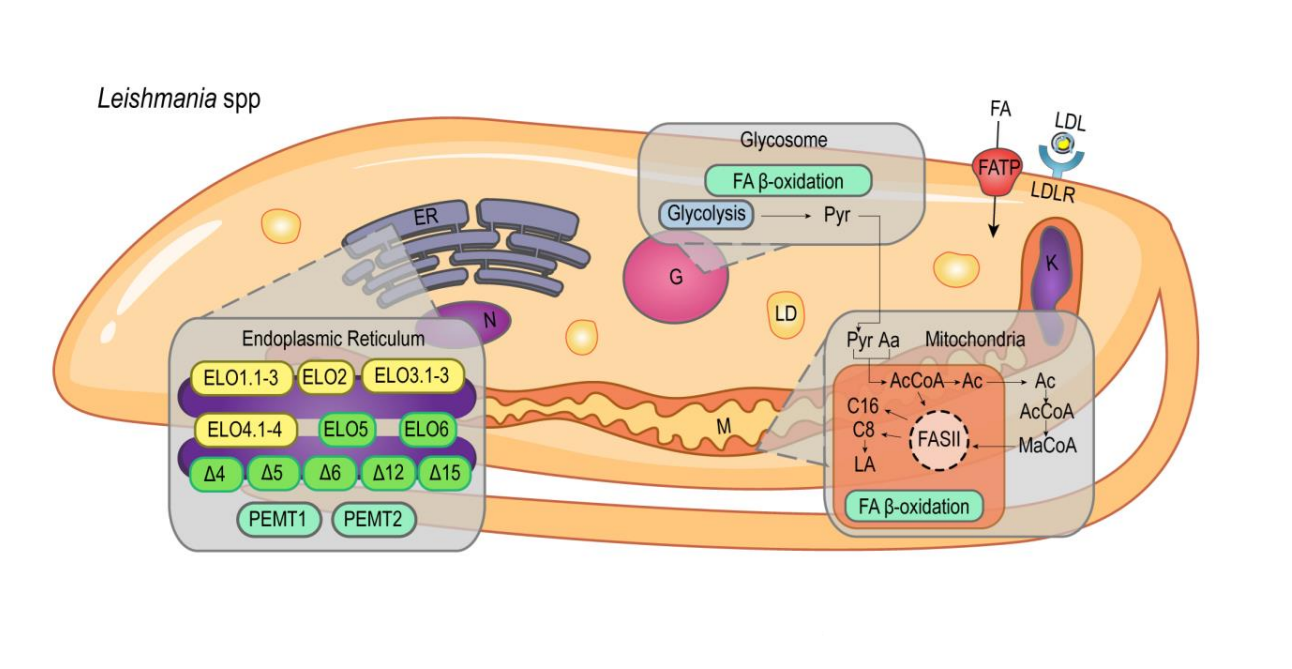
Lipid and fatty acid metabolism in trypanosomatids
Giovana Parreira de Aquino1,#, Marco Antonio Mendes Gomes1,#, Roberto Köpke Salinas2 and Maria Fernanda Laranjeira-Silva1
This work reviews specific aspects of lipid and fatty acid metabolism in the protozoan parasites T. brucei, T. cruzi, and Leishmania spp., as well as the pathways that have been explored for the development of new chemotherapies.

Using microbial metalo-aminopeptidases as targets in human infectious diseases
Jorge González-Bacerio1,2, Maikel Izquierdo1, Mirtha Elisa Aguado1, Ana C. Varela1, Maikel González-Matos1 and Maday Alonso del Rivero1
This Review highlights the relevant roles of microbial metalo-aminopeptidases in bacteria and protozoa that could be targeted for therapeutic purposes.

Understanding the pathogenesis of infectious diseases by single-cell RNA sequencing
Wanqiu Huang1, Danni Wang1 and Yu-Feng Yao1,2
This work highlights recent remarkable advances in single-cell RNA sequencing technologies and their applications in the investigation of host-pathogen interactions. Current challenges and potential prospects for disease treatment are discussed as well.
Effects of the intestinal microbiota on prostate cancer treatment by androgen deprivation therapy
November 15, 2022
Prostate cancer (PC) can be kept in check by androgen deprivation therapy (ADT, usually with the androgen synthesis inhibitor abiraterone acetate or the androgen receptor antagonist such as enzalutamide) until the tumor evolves to castration-resistant prostate cancer (CRPC). The transition of hormone-sensitive PC (HSPC) to CPRC has been explained by cancer cell-intrinsic resistance mechanisms. Recent data indicate that this transition is also marked by cancer cell-extrinsic mechanisms such as the failure of ADT-induced PC immunosurveillance, which depends on the presence of immunostimulatory bacteria in the gut. Moreover, intestinal bacteria that degrade drugs used for ADT, as well as bacteria that produce androgens, can interfere with the efficacy of ADT. Thus, specific bacteria in the gut serve as a source of testosterone, which accelerates prostate cancer progression, and men with CRPC exhibit an increased abundance of such bacteria with androgenic functions. In conclusion, the response of PC to ADT is profoundly influenced by the composition of the microbiota with its immunostimulatory, immunosuppressive and directly ADT-subversive elements.
Occurrence and potential mechanism of holin-mediated non-lytic protein translocation in bacteria
September 23, 2022
Holins are generally believed to generate large membrane lesions that permit the passage of endolysins across the cytoplasmic membrane of prokaryotes, ultimately resulting in cell wall degradation and cell lysis. However, there are more and more examples known for non-lytic holin-dependent secretion of proteins by bacteria, indicating that holins somehow can transport proteins without causing large membrane lesions. Phage-derived holins can be used for a non-lytic endolysin translocation to permeabilize the cell wall for the passage of secreted proteins. In addition, clostridia, which do not possess the Tat pathway for transport of folded proteins, most likely employ non-lytic holin-mediated transport also for secretion of toxins and bacteriocins that are incompatible with the general Sec pathway. The mechanism for non-lytic holin-mediated transport is (...)
Pirates of the haemoglobin
February 18, 2022
Not all treasure is silver and gold; for pathogenic bacteria, iron is the most precious and the most pillaged of metallic elements. Iron is essential for the survival and growth of all life; however free iron is scarce for bacteria inside human hosts. As a mechanism of defence, humans have evolved ways to store iron so as to render it inaccessible for invading pathogens, such as keeping the metal bound to iron-carrying proteins. For bacteria to survive within humans, they must therefore evolve counters to this defence to compete with these proteins for iron binding, or directly steal iron from them. (...)
Endomembrane remodeling and dynamics in Salmonella infection
December 27, 2021
Salmonellae are bacteria that cause moderate to severe infections in humans, depending on the strain and the immune status of the infected host. These pathogens have the particularity of residing in the cells of the infected host. They are usually found in a vacuolar compartment that the bacteria shape with the help of effector proteins. Following invasion of a eukaryotic cell, the bacterial vacuole undergoes maturation characterized by changes in localization, composition and morphology. In particular, membrane tubules stretching over the microtubule cytoskeleton are formed from the bacterial vacuole. Although these tubules do not occur in all infected cells, they are functionally important and promote intracellular replication. This review focuses on the role and significance of membrane compartment remodeling observed in infected cells and the bacterial and host cell pathways involved.
Lipid and fatty acid metabolism in trypanosomatids
October 6, 2021
This work reviews specific aspects of lipid and fatty acid metabolism in the protozoan parasites T. brucei, T. cruzi, and Leishmania spp., as well as the pathways that have been explored for the development of new chemotherapies.
Understanding the pathogenesis of infectious diseases by single-cell RNA sequencing
August 4, 2021
This work highlights recent remarkable advances in single-cell RNA sequencing technologies and their applications in the investigation of host-pathogen interactions. Current challenges and potential prospects for disease treatment are discussed as well.
Exploring absent protein function in yeast: assaying post translational modification and human genetic variation
July 2, 2021
This review discusses the applicability of yeast systems to investigate absent human protein function with a specific focus on the impact of protein variation on protein-protein interaction modulation.
Mechanisms underlying lactic acid tolerance and its influence on lactic acid production in Saccharomyces cerevisiae
April 14, 2021
This article reviews the manner in which Saccharomyces cerevisiae deals with the accumulation of lactic acid as a singular stress factor as well as in combination with other stresses. In addition, different methods to improve lactic acid tolerance in S. cerevisiae using targeted and non-targeted engineering methods are discussed.
Biofilms by bacterial human pathogens: Clinical relevance – development, composition and regulation – therapeutical strategies
February 1, 2021
This review focuses on bacterial biofilms formed by human pathogens, highlights their relevance for diverse diseases and discusses therapeutical intervention strategies targeting biofilms.